

Epilepsy Monitoring Unit
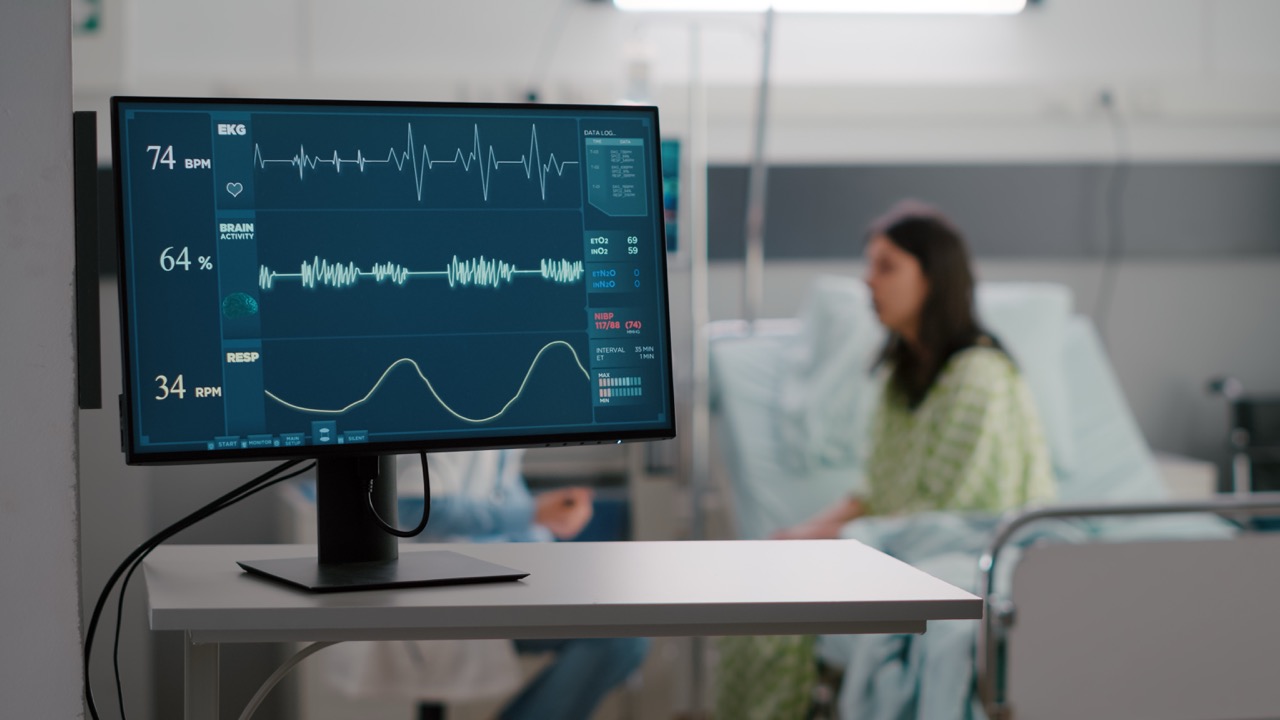
An epilepsy monitoring unit runs on continuity. Patients are admitted for days, recorded around the clock, and the events that matter — seizures — are rare, brief, and unpredictable. Miss the recording window or lose a channel overnight and you may have to extend an expensive admission to capture what you came for.
This use case shows how an EMU runs continuous long-term video-EEG on Qusp, with automated event flagging that surfaces the handful of clinically important moments out of days of recording — so clinicians review minutes instead of hours.
The setup
The unit records continuously, 24/7, with EEG and synchronized video on one timeline. Rather than relying on a technician to catch events live, Qusp flags candidate events automatically and writes everything to disk so nothing is lost between rounds. Review happens against the full recording, not a triggered subset.
The deployment has four parts:
- Continuous acquisition — Around-the-clock EEG at a clinical montage and sampling rate, recorded without gaps for the length of the admission.
- Synchronized video — Bedside video locked to the EEG timeline, so every flagged event can be reviewed against what the patient was doing.
- Automated flagging — Candidate seizures and abnormal patterns are detected and marked in real time, turning days of data into a short review list.
- Full-session replay — Clinicians scrub the entire recording with events bookmarked, rather than trusting that the right window was captured.
How a typical admission runs
On admission, the patient is hooked up to the clinical montage and recording starts. From that point the EEG and video run continuously, writing to disk in real time, with state preserved across any interruption.
Through each day and night, Qusp runs detection on the live stream, flagging candidate seizures, spikes, and abnormal rhythms. Each flag is timestamped on the shared EEG-video timeline so it can be jumped to instantly.
Each morning, the reviewing neurologist opens the event list rather than the raw recording. Overnight events are already bookmarked; confirming or dismissing them takes minutes, and genuine seizures are escalated immediately.
Over the admission, confirmed events accumulate into a clean clinical summary — counts, timing, and localization — without anyone having to scrub days of EEG by hand.
What's recorded
Every admission captures the same core streams:
- Clinical EEG montage — A full long-term montage at 256 Hz or higher, recorded continuously for the length of the stay.
- Time-locked video — Bedside video synchronized to the EEG, so behavior and electrographic activity line up to the second.
- Event metadata — Every flag, confirmation, and annotation is stored with the recording, building an auditable record of the admission.
Compare that to triggered or technician-dependent capture, where a missed button-press or an unattended hour can lose the one seizure of the admission. Continuous recording with automated flagging means the event is always in the data; the only question is reviewing it, not whether it was caught.
The outcomes
An EMU running this pattern typically sees:
- Nothing missed — Continuous capture means every event is in the recording, even the ones no one was watching for.
- Faster review — Clinicians read a flagged event list instead of scrubbing days of EEG, cutting review time dramatically.
- Shorter admissions — Catching the needed events reliably reduces the odds of extending an expensive monitoring stay.
- Defensible records — Every event and annotation is timestamped and stored, giving a complete, auditable history of the admission.
- Less technician load — Automated flagging removes the pressure of catching every event live, around the clock.
Where it doesn't fit
Continuous video-EEG with automated flagging fits inpatient epilepsy monitoring and long-term diagnostic recording. Three caveats are worth naming.
First, automated flagging assists review; it doesn't replace the neurologist. Every flagged event still needs clinical confirmation, and subtle events may need a trained eye regardless.
Second, ambulatory settings without video. The full value comes from time-locked video; purely ambulatory recordings get the continuity but lose the behavioral context.
Third, detection tuning. The sensitivity and specificity of flagging depend on montage and population; a new unit should expect a tuning period before the event list is as clean as it gets.
Standing it up
Most units get this running in a few weeks. The first step is defining the clinical montage and recording specification. The second is integrating bedside video onto the EEG timeline and validating synchronization. The third is tuning detection thresholds against the unit's own patient population.
Clinical staff who run the unit should own the configuration. The people reviewing events know which patterns matter, and their input is what makes the flagging useful rather than noisy.
Bring this to your unit
If you run an epilepsy monitoring unit or long-term video-EEG service, Qusp can give you continuous capture, synchronized video, and automated event flagging on one timeline. Talk to our team about montage setup, video integration, and tuning detection to your population.