

Multi-Site Sleep Study
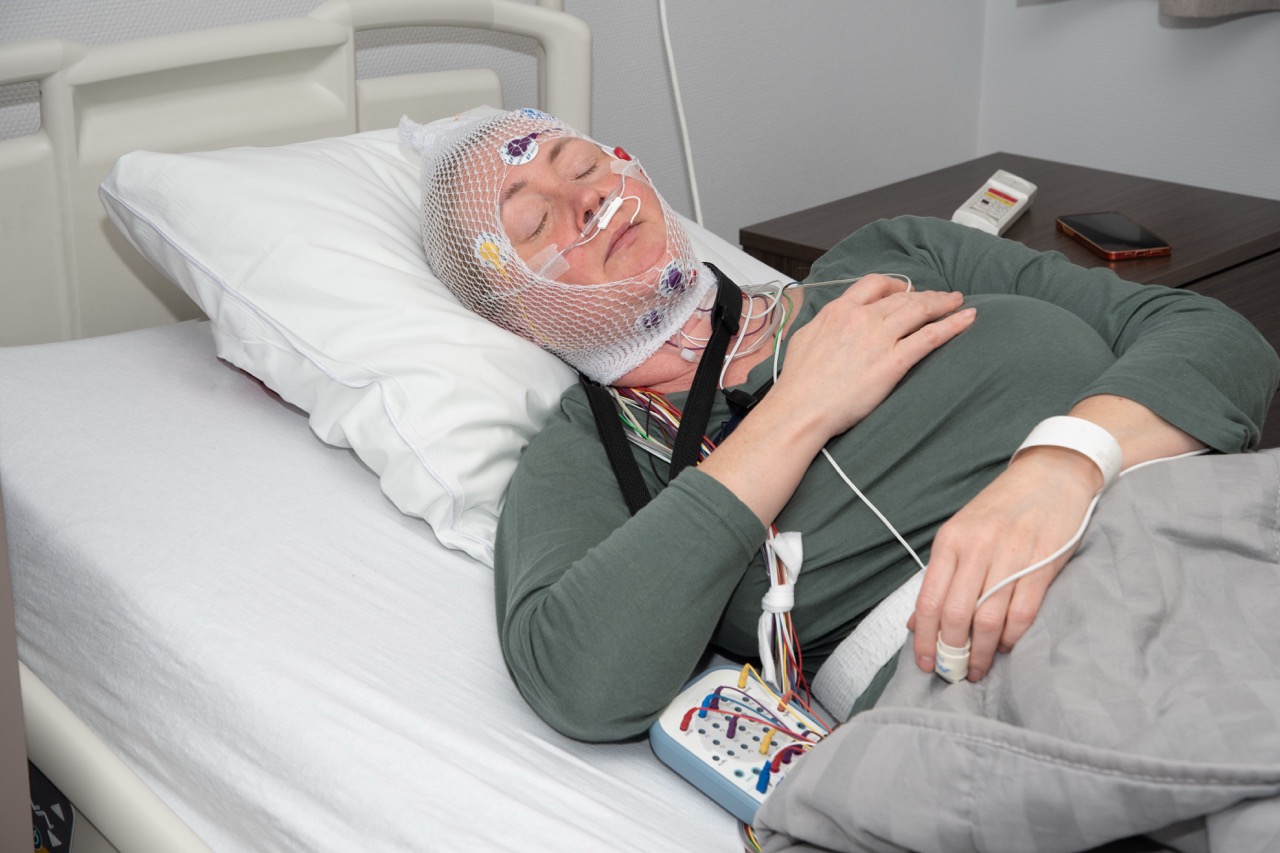
For a multi-center sleep study, the science is rarely the hard part — consistency is. Each site has its own technicians, its own amplifiers, and its own habits for labeling stages and seating electrodes. Run that across eight centers and months of overnight sessions, and a single study quietly fractures into eight subtly different datasets that no amount of analysis can fully reconcile.
This use case shows how a sleep-research network runs all eight sites on Qusp under one shared protocol — every montage, sampling rate, and quality threshold identical — so recordings land in one unified dataset that's ready to analyze the morning after each night.
The setup
The principle is simple: one protocol, enforced by the platform, not by a PDF nobody reads. A central study template defines the montage, sampling rate, filters, and quality thresholds. Every site inherits it. Local technicians run sessions; Qusp handles synchronization, validation, and storage so nothing depends on a site remembering to do it right.
The deployment spans four coordinated parts:
- Study template — One canonical montage, sampling rate, reference, and filter set that every site inherits. Change it once and all sites update.
- Site acquisition — Each center records locally against the shared template, on whatever supported amplifier it already owns, with no per-site reconfiguration.
- Live quality checks — Every overnight session is scored for signal quality automatically, so a bad setup is flagged the next morning, not at the end of the study.
- Central dataset — Recordings sync into one unified, BIDS-ready store with uniform metadata, so cross-site analysis is a query rather than a cleanup project.
How a typical night runs
In the evening, the technician at each site starts a session from the shared template. The montage, sampling rate, and impedance thresholds are already set — there's nothing to configure and nothing to get wrong. Recording runs overnight, writing continuously to disk.
Through the night, Qusp checks signal quality on a rolling basis — impedance, flat or railing channels, and drift. A long recording is exactly where things silently fail: a channel loosens at 3 a.m., a disk fills. State is written continuously and recovers cleanly from interruptions, so the night survives.
By morning, the completed session has synced to the central dataset with its quality report attached. The study coordinator sees coverage across all eight sites in one view and can flag a re-run while the participant is still reachable.
Across the week, the coordinator tracks completed nights per site against the target, chasing gaps immediately instead of discovering missing data during analysis months later.
What every site runs
Each site records to the same specification:
- 32-channel montage — A fixed 32-channel sleep montage at 256 Hz, identical at every site, with EOG, EMG, and ECG channels included.
- Shared references and filters — One reference scheme and filter set, so no site introduces its own preprocessing before the data is even stored.
- Uniform metadata — Every recording carries the same structured fields — site, montage, stage labels — making the combined dataset queryable out of the box.
Compare that to the usual multi-site reality: each center exports its own files, in its own format, with its own naming, and a data manager spends the back half of the study reconciling them by hand. That reconciliation is where errors creep in and timelines slip. Enforcing one protocol up front removes the entire step.
The outcomes
A network running this pattern typically sees five things hold across the study:
- Zero lost nights — Continuous writes and crash recovery mean an eight-hour recording survives the small failures that used to cost a whole session.
- One analysis-ready dataset — All eight sites land in a single unified store, with no manual reconciliation at the end of the study.
- Consistent scoring — Every site uses the same montage and thresholds, so stage scoring and signal quality are comparable across centers.
- Faster turnaround — Quality issues surface the next morning, not months later, so re-runs happen while participants are still enrolled.
- Easy expansion — Adding a ninth or tenth site means handing them the same template — no renegotiation, no new pipeline.
Where it doesn't fit
This pattern fits structured, protocol-driven research — sleep studies, multi-site clinical trials, registries. It's a weaker fit in three situations worth naming.
First, exploratory single-site work. If you're still iterating on the montage and paradigm week to week, locking a shared template adds friction you don't need yet.
Second, highly heterogeneous hardware. The pattern assumes every site can run the shared montage; sites with incompatible amplifier channel counts need their setup reconciled before they join.
Third, studies without a coordinating center. The model depends on someone owning the canonical template and watching coverage. Without that role, consistency drifts no matter how good the tooling is.
Standing it up
Most networks get this running in a few weeks. The first week is defining the canonical template — montage, sampling rate, references, thresholds — and validating it on one site. The second is onboarding the remaining sites against that template and running an end-to-end test night. The third is tuning quality thresholds to each site's room and hardware.
The coordinating center should own the template, not each individual site. Centralizing that one decision is what keeps eight sites recording the same study instead of eight similar ones.
Bring this to your network
If you're planning a multi-site EEG or sleep study, Qusp can give every site one shared protocol and one unified dataset from the first night. Talk to our team about templating your montage, onboarding your centers, and standing up live quality monitoring across all of them.